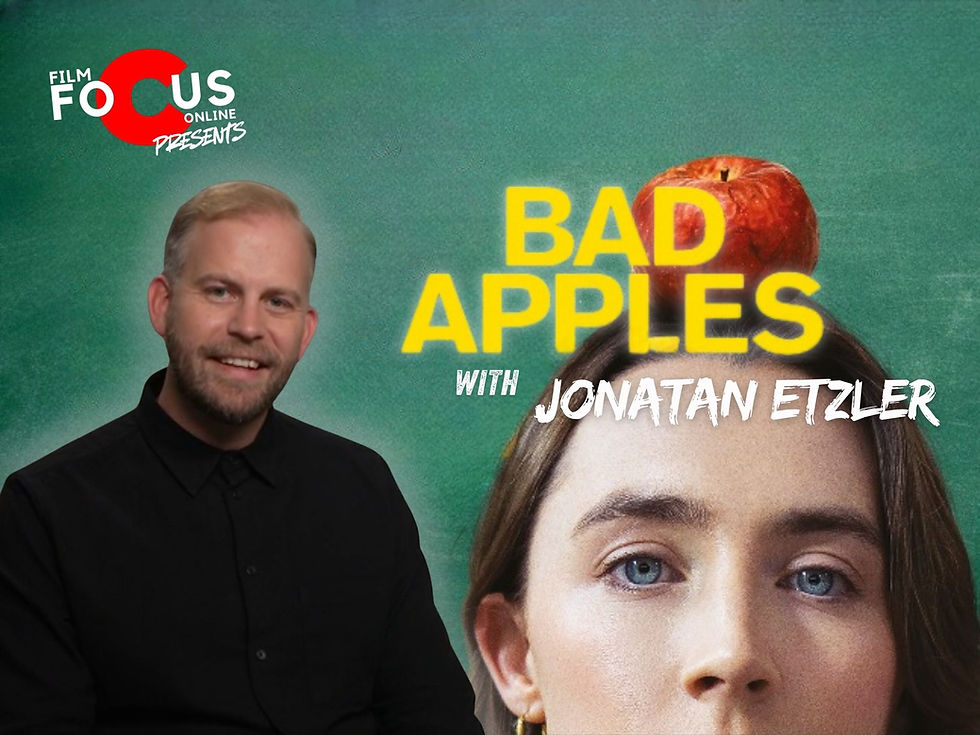
'Bad Apples' Review: Saoirse Ronan Leads a Sharp Satire on a Town Happy to Look the Other Way

By Shauna Bushe - September 16, 2026
What happens when removing the problem is easier than fixing the system that created it? Bad Apples takes that uncomfortable question and locks it in a basement, then sits patiently beside it to see how long our morality lasts.
What is Bad Apples about?
Directed by Jonatan Etzler, Bad Apples follows Maria (Saoirse Ronan) an exhausted primary school teacher whose classroom has been constantly hijacked by one destructive pupil, Danny (Eddie Waller). Following a violent confrontation Maria finds herself in an unimaginable situation: Danny ends up locked in her basement. Rather than rectifying her decision Maria hesitates to release him, realizing her classroom is flourishing in his absence. What unfolds is an outrageous premise that collectively challenges morals and how far those involved will go for the greater good.
Bad Apples isn’t looking to excuse what Maria has done but is asking the audience to look closer at how quickly everyone around her benefits. Danny’s disappearance has become an unspoken solution. Nobody has to confront the consequences of his behaviours because the problem is no longer visible. The school can focus on better results. Parents can feel safer about their children. Maria can finally appear competent. It a win-win, right? However, this mutual relief comes at a steep ethical cost and for Maria, her superficial victory is a trap of its own.
The film’s tonal shift is accompanied by a sweeping change in visual style. Etzler sharply contrasts the bright, seemingly excelling school classroom with the cold, isolated, grey-scaled basement where Danny is kept. Outside, the vibrant performative energy mimics the desire to produce success and normalcy. Inside however, the drained colour palette exposes the heinous reality of Maria’s compromise.
This unsettling duality relies entirely on the character of Maria, a role very different to any other in Saoirse Ronan’s career. Known for more empathetic, grounded characters, here we see her unravel, panicked and visibly fractured in every sense. Ronan strips herself a that familiar warmth to play a fragile, tightly wound teacher on the edge of collapse. It’s precisely within her character that the films satirical and dark comedy elements thrive. The humour doesn’t come from the big plot device but from the absurd lengths to which Maria will go in order to maintain the illusion of a “correct” world above. Watching Maria prepare a meal of pesto pasta for Danny is such a bizarre, desperate attempt at appearing normal; although it’s played with an earnest, almost motherly devotion rather than villainous malice, it still feels incredibly out of place, adding to the films ridiculous humour.

Additionally, the supporting characters reinforce the film’s central theme of sacrificing a “bad apple” to maintain a false sense of peace for the rest of the combined. Head Teacher Sylvia (Rakie Ayola) actively chooses to abandon her position, rather than fix the broken system. Similarly, Sam (Jacob Anderson) an opportunistic teacher, prioritises his own promotion, deliberately acting as if Danny has vanished while fully knowing exactly where he is; a complicity shared by the rest of the families. This self-serving apathy extends to students also, Paulina (Nia Brown) an ambitious, but irritating pupil who chooses to exploit the situation after learning Danny’s location to intimidate Maria for personal leverage. Together, their actions expose an environment where personal advancement and comfort override moral responsibility.
Ultimately, the narrative's final verdict is clear: by choosing self-preservation over justice, these characters prove that the "bad apple" is merely a scapegoat used to protect and cover up a thoroughly broken system. Etzler’s Bad Apples is a deliciously, uncomfortable ride, driven by magnetic performances in Ronan and Waller. It makes you laugh when you shouldn’t and squirm in your seat. Going in blind proves to be the best experience.
'Bad Apples' releases in cinemas on Friday September 18, 2026.

Want more film reviews? Dive into more reviews, rankings, and film conversations on our site.
Explore Film Focus Online now!


Shauna Bushe
Writer
Shauna is always down to talk about movie lore, collector of all things physical media and driven by a life long love for horror cinema.
Want your film or TV show reviewed by Shauna? Contact us.