


'Dogma' at 25: Kevin Smith’s Boldest Film Finds New Life in 4K

By Dan Bremner - November 15, 2025
After years of frustrating rights limbo (Mostly due to Harvey Weinstein holding onto them), Dogma is finally back where it belongs, in Kevin Smith’s hands, and once again gracing the big screen in a new 4K remaster for its so-called “25th Anniversary” (actually 26th, but who’s counting). Seeing it on the big screen again after so long (I don't think I've seen it since school, so about 15 years), in all its irreverent, audacious glory, is a reminder of just how daring and distinctive it still feels.
Dogma’s Return: A Controversial Classic Finds New Life
Released in 1999 at the height of Smith’s creative streak, Dogma remains one of the most ambitious and controversial films of its era, a film that generated outrage, protests, and even death threats for its gleefully blasphemous take on Catholicism. But, despite all this controversy, it ended up being one of Smith's highest grossing films (Earning $55m on a $10m budget. Controversy can often pay off!). Two decades later, the controversy feels quaint, but the film’s boldness, humour, and sincerity have only grown sharper with time.
Of course, no discussion of Dogma is complete without addressing the controversy. Upon release, the film was targeted by the Catholic League, accused of blasphemy, and protested across the U.S. Kevin Smith himself famously joined one of the protests incognito, holding a sign that read “Dogma is Dogshit.” Looking back, the outrage seems misplaced as Dogma isn’t anti-faith, it’s anti-hypocrisy. It’s not a mockery of God, but of institutions that exploit belief for control. Ironically, it’s one of the most pro-faith films ever made by a self-proclaimed lapsed Catholic. Smith’s message, that religion should inspire compassion, not division, remains as relevant as ever. I don't think there was a more perfect time to re-release this.

What makes Dogma so fascinating is that it walks a tonal tightrope few filmmakers could ever pull off: it’s simultaneously an irreverent comedy, a theological debate, a road movie, and a surprisingly heartfelt meditation on faith. The film’s premise of two fallen angels (Ben Affleck and Matt Damon) trying to exploit a loophole to re-enter Heaven, risking the annihilation of all creation is absurd, but Smith uses it as a platform to explore deeply human ideas about belief, dogma, and forgiveness. Beneath the profanity and dick jokes lies one of the most earnest explorations of spirituality ever put to screen, told through the lens of a foul-mouthed Jersey philosopher.
A Heavenly Cast: The Performances That Make Dogma Endure
Armed with a stacked cast of Smith regulars and big names, the cast is astoundingly rich. Ben Affleck and Matt Damon, fresh off Good Will Hunting, bring both gravitas and gleeful mischief to their roles as the wayward angels Bartleby and Loki. Damon’s scenes of violent righteousness contrast brilliantly with Affleck’s more introspective crisis of faith, grounding the cosmic absurdity with genuine pathos. Linda Fiorentino gives one of her most overlooked performances as Bethany, the reluctant protagonist whose crisis of belief mirrors the audience’s own struggle to balance reason and faith. The late and dearly missed Alan Rickman, as the sardonic Metatron (the “Voice of God”), is an absolute delight, dry, sharp, and perfectly weary. Chris Rock, Salma Hayek, Jason Lee and Jason Mewes & Kevin Smith’s Jay and Silent Bob round out the ensemble with infectious energy, and George Carlin’s brief but memorable turn as Cardinal Glick adds the perfect note of satire.
Smith’s writing here is some of his smartest and most ambitious. The dialogue is razor-sharp, packed with pop-culture riffs, philosophical debates, and theological musings, yet it never loses sight of character or humour. The way he manages to weave moral inquiry around dick jokes without ever feeling insincere is a kind of miracle in itself. The film's funniest moments often coexist with moments of profound sincerity, like the idea that “It’s better to have ideas than beliefs,” or that faith is something to be questioned, not blindly followed. That balance, the ability to mock and revere simultaneously is the film’s greatest strength. As much as Smith likes to say he's written a sequel (Adding to a long list of “Announced” sequels like Mallrats 2 and Moose Jaws that never happened), this really works as a one and done, and I don't think Smith has anything close to the creative juice anymore to make a worthwhile follow-up. So best to let this one rest in peace.
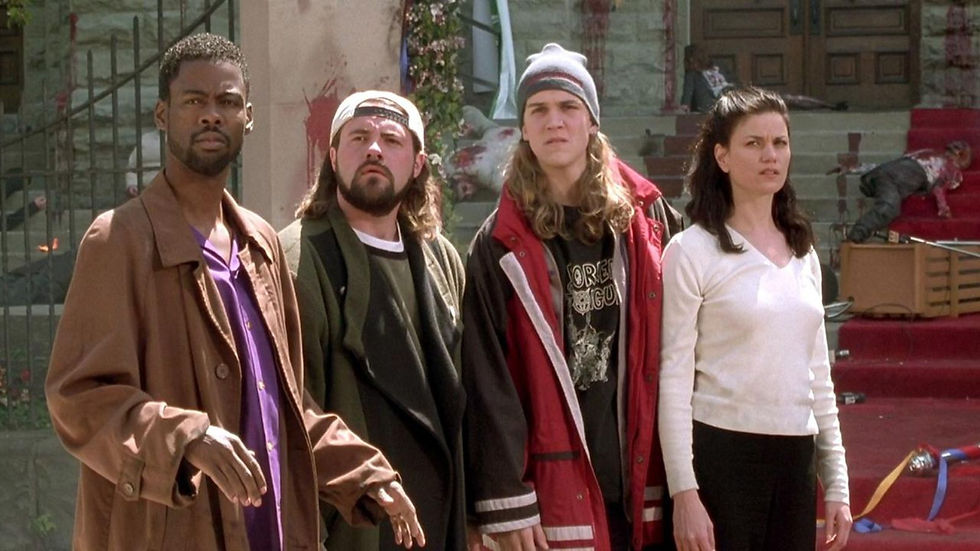
Even with a strong new 4K remaster, It’s a bit rough around the edges, as the cinematography is functional rather than stylish, and the effects are often dated but the scrappiness feels in tune with Smith’s voice. He’s never been about spectacle, but about dialogue and heart, and even in this fantasy-inflected context, his strengths shine through. The film’s energy and inventiveness make up for its technical limitations, though a few sequences (especially toward the finale) could have benefited from a tighter edit or more restraint.
As much as I do like Dogma, I do find it’s overstretched, unevenly paced, and occasionally bogged down by Smith’s tendency to overexplain. Some sequences stretch the runtime unnecessarily, especially in the middle act, where theological debates start to meander. It could easily lose 15 minutes without sacrificing its impact. But even in its clutter, there’s something charming about its ambition. You can feel Smith pouring his heart into every line of dialogue, every debate about faith and morality. While I understand how a lot of people find this to be the best of Smith's filmography, I do have a softer spot for the tighter Clerks and Mallrats.
A Blasphemous Classic That Still Has Something to Say
Dogma finally re-released for its “25th” anniversary was a delight. It's not perfect, but it's a frequently hilarious, sharply written and perfectly cast satirical comedy that has aged like fine wine when it comes to Smith’s takedown of organised religion and all the hypocrisy that comes with it. A wonderful relic from before Smith got lost in his self-referential work, and was instead a bold and provocative filmmaker.


