'Last Stand at Butte City' Review: A Powerful Western About Grief, Loss and Letting Go

By Elliot Lines - September 24, 2026
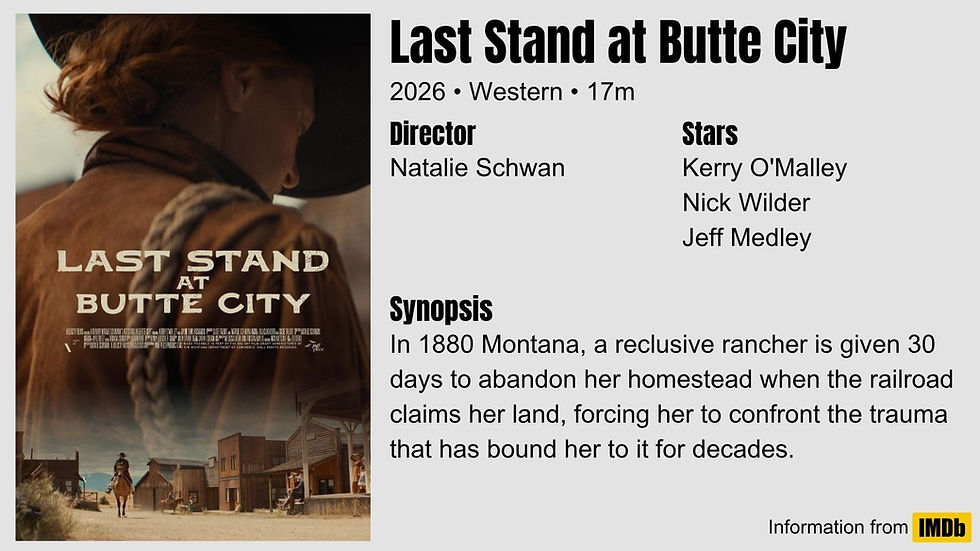
The Western is a genre that has never been afraid to explore the idea of standing your ground. Whether facing an outlaw, a rival or an advancing force of change, there is something cinematic about a character refusing to give up what they have built. Natalie Schwan's Last Stand at Butte City takes that familiar idea and gives it a much more personal meaning, using the backdrop of 1880s Montana to explore grief, memory and the difficulty of moving forward after loss.
What is 'Last Stand at Butte City' about?
The short follows Charlotte, a reclusive rancher who has spent more than three decades living on her homestead. When representatives of the Northern Pacific Railway arrive with an eviction notice, informing her that she has 30 days to leave so the railroad can claim her land, Charlotte refuses to accept that the place she has called home for so long can simply be taken away.
What makes Last Stand at Butte City work is the way Schwan gradually reveals what Charlotte is actually fighting for. On the surface, this is a fairly traditional Western setup, with the arrival of the railroad providing an external threat and Charlotte refusing to give up her home. Yet the further the story progresses, the more apparent it becomes that the conflict is an internal one. The land represents a connection to the life Charlotte once had, and her determination to remain there is as much about holding onto the past as it is about protecting her home.
Kerry O'Malley gives the character the necessary restraint, allowing Charlotte's grief to come through in her expressions and actions rather than relying on lengthy explanations. Jamie Lynn Richards also makes an impression as the younger Charlotte, with the two performances working together to give the character a greater sense of history.
Schwan also demonstrates an understanding of how much atmosphere can contribute to a short film. The Montana landscapes provide an appropriately imposing backdrop, while the production design and period detail help establish the world without distracting from the central character. There is a patience to the film, allowing Charlotte's isolation to become part of the story rather than simply using the Western setting as decoration.
Ultimately, Last Stand at Butte City is less interested in the traditional Western showdown than it initially appears to be. Beneath the horses, homestead and looming presence of the railroad is a thoughtful story about what happens when grief becomes so closely tied to a place that letting go can feel like losing someone all over again. The short runtime means there are moments where Charlotte's history could have benefited from further exploration, but Schwan still manages to give her journey a satisfying emotional arc.
'Last Stand at Butte City' was selected to the 2026 Lighthouse Int’l Film Festival.

Want more short film reviews? Dive into more reviews, rankings, and film conversations on our site.
Explore Film Focus Online now!

Elliot Lines
Founder/Lead Editor
Elliot loves to surround himself with all things movies. Whether that be his movie related LEGO collection or enough Blu-rays to restart blockbuster.
Want your film or TV show reviewed by Elliot? Contact us.