


The Faces of Jason: Unpacking the Cultural Bloodstream of a Slasher Icon
By Shauna Bushe - May 5, 2026
This year, we celebrate the 45th anniversary of Friday the 13th Part 2, the chilling follow-up that cemented the franchise’s identity, refining the template with a more grounded, suspense-driven approach to terror. To mark this major milestone, we’re peeling back the iconic hockey mask to explore the evolution of horror’s favourite son. From the vengeful woodsman to the meta-monster that defined a decade, join us as we chronicle the many faces of the man, the myth, the indestructible legend, Jason Voorhees.
In the beginning, it was vengeful Pamela Voorhees who operated as the primary antagonist, methodically picking off the counsellors of Camp Crystal Lake to avenge the drowning of her son Jason. And Alice Hardy emerged as the first definitive “Friday Final Girl”. However, this standalone slasher was transformed into a multi-decade saga by its own iconic concluding jump scare: a decomposed Jason rising from the depths to pull Alice into the lake. This sequence served as the ultimate catalyst for the franchise. Jason’s trauma effectively recontextualized him, shifting his role from a tragic victim to a silent, unstoppable force of nature who created his own celebrated, masked reign of terror.
Over the decades, Jason has been portrayed by a variety of actors and stuntmen, each adding a unique physical language to the oddity while his mask became its own evolving character. Here’s a deep dive into one of horror cinemas most resilient titans:
Friday the 13th Part II (1981) – Warrington Gillette, Steve Dash & Ellen Lutter
While the hockey mask is iconic, the burlap sack of Part II is where the nightmare truly originated. This iteration of Jason was a collaborative struggle, brought to life by a trio of performers and unique piece of costume history. While many associate the role with a single ‘stuntman’, three different actors shared the mantle for Jason's official first appearance. Steve Dash as the primary pillar, handling most of the action and stunts behind the sack. Warrington Gillette then took over for the pivotal unmasked sequences during the films closing moments. And in a fascinating bit of trivia, the films costume designer provided the legs for Jason’s opening stroll: this earned her the nickname “Lady Jason”, making her the only female to ever officially portray the character. As for costume history, the burlap sack was inspired by The Town That Dreaded Sundown (1976), specifically a direct homage to the phantom killer. Its ‘backwoods cannibal’ aesthetic is still a fan favourite to this day.
Friday the 13th Part III (1982) – Richard Brooker

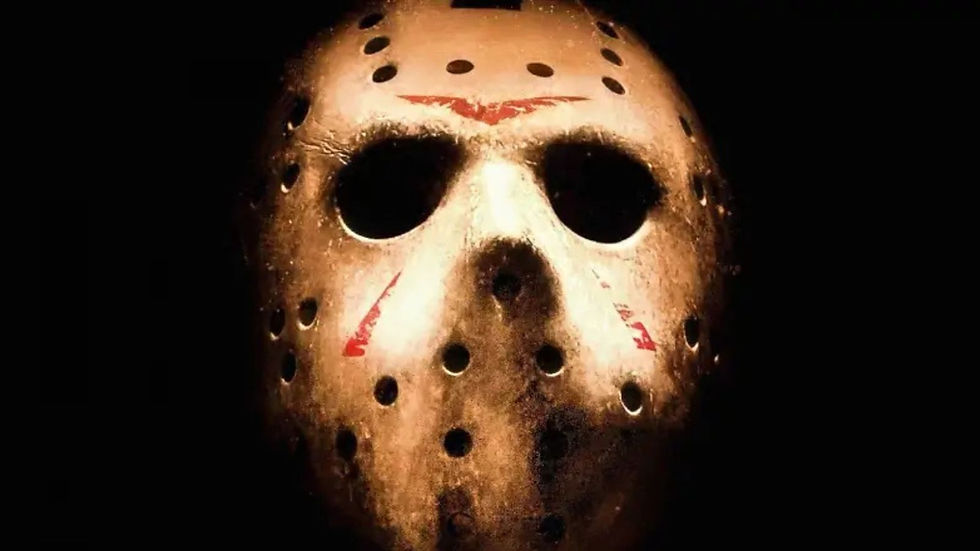
Part III finally introduced the signature hockey mask and was the first time an actor (Richard Brooker) portrayed Jason for an entire movie. Brooker brought a distinct athleticism to the role, a looming, powerhouse hunter who moved with a predatory motive. His Jason didn’t just hide in the shadows; he occupied space, with a sense of physical dominance. Perhaps the most significant contribution to Brookers duration was the debut of the hockey mask: a clean, white fiberglass shell that was modified to feature three red triangles, one pointing down from the forehead, two pointing up from the cheeks and 11 drilled holes. The mask was not part of the original design, but it was a fortuitous addition provided by 3-D effects supervisor Martin Jay Sadoff, giving Jason his key signature blank, pale, emotionless stare.
Friday the 13th: The Final Chapter (1984) – Ted White
The Final Chapter is a pivotal entry for a few reasons; one it features exactly 13 kills, introduces Cory Feldman as Tommy Jarvis and at 58 years old welcomes Ted White, the oldest to ever play Jason. White was a veteran stuntman who brought a professional, high intensity edge to the slasher icon, whilst previous versions were often slow and hovered, White played Jason as a fast, lethal and efficient killer. He crashed through windows and smashed through doors with a terrifying volatile energy making his character feel more dangerous than ever. White went so far as to refuse any interaction with the teenage cast members on set to maintain a genuine sense of intimidation. The Final Chapter tells the story of Jason’s physical resilience through altercations on his mask. No longer appearing as a new piece of costume wear, but a scarred relic of his encounters. Featuring a deep bloody gash in his forehead, a direct continuity from Part III, and shifted texture from pristine white, to a yellowish grey. By the time the mask is finally removed, White has successfully cemented Jason as the ultimate apex predator.
Friday the 13th: A New Beginning (1985) – Tom Morga & Dick Wieand
Famously known for its controversial twist ending (SPOILER ALERT) where the killer is Roy Burns, A New Beginning developed a reputation for being the weaker entry. However, even with the lack of ‘real’ Jason it is still often praised for its fun 80s slasher atmosphere, creative kills and strong chase scenes. Stuntman Tom Morga provided screentime for most of the kills, but his character wasn’t really Jason Voorhees, it was Roy Burns played by Dick Wieand, a grieving paramedic driven to a murderous breakdown. Since the real hockey mask was buried with Jason, the ‘Roy Jason’ mask was a recreation that featured several key differences to signal to the audience that something was ‘off’: the signature red triangles were replaced by blue ones and notably missing the axe-cleft from Part III. By ditching the traditional shirt-and-trousers pairing, the design of dark blue-grey mechanic coveralls granted the killer a rigid, functional silhouette that perfectly complemented the imposter narrative.
Jason Lives: Friday the 13th Part VI (1986) – C.J. Graham & Dan Bradley
Part VI is famously recognised for resurrecting Jason Voorhees as a supernatural zombie and featuring his iconic bullet hole damaged hockey mask. Stuntman Dan Bradley played Jason on the first day but was deemed too bulky by director Tom McLoughlin, he was later replaced with C.J. Graham: a former marine, for the rest of the movie. Graham’s Jason was calm, deliberate, and introduced the “head tilt” to the character, this stiff-neck posture made Jason look less like a man and more like a statue brough to life. Graham was a powerhouse who didn’t need to run, he moved with a robotic purposeful stride that lingered. Cited by fans, this Jason was the first to fully embrace the utility belt and gloves look, and his gear underwent a significant change too: bringing back the familiar triangles but had them appear more sharply defined and smaller than the previous films. Jason Lives revitalized the genre and embraced the absurdity of meta-commentary, with Kevin Williamson acknowledging the influence this entry had on his concepts of Scream (1996).

Friday the 13th Part VII: The New Blood (1988) – Kane Hodder
What was intended to be a crossover with A Nightmare on Elm Street, pitting Jason Voohees (Kane Hodder) against Freddy Kruger (Robert Englund), fell through during negotiation stages and the script was rewritten to feature a telekinetic protagonist, Tina Shepherd played by the late Lar Park Lincoln. The New Blood would become synonymous with Kane Hodder, remaining the only character to play the part for 4 consecutive films. The physicality of Hodder set his Jason apart from the others immensely, developing a signature heavy breathing technique where his chest and shoulders would heave aggressively, giving the impression that Jason was a pressure cooker of rage. Often, Hodder wouldn’t blink whenever the camera was on him, creating a shark-like nature to his performance and was set on fire for a record breaking 40 seconds during the films climax. His mask was also wildly considered the most battle worn, displaying years of decay and rotting after being chained underwater since the previous film. Kane Hodder is the fan favourite Jason for many reasons: his ability to convey emotions, and pain through a mask using only body language and head tilts was unprecedented. He embraced the horror community by often choking fans in pictures, attending conventions, fortifying his personal bond that no other Jason has ever quite established. For many, the “zombie Jason” of the Hodder era is the most visually striking version, a skeletal-slimy monster that looked exactly as a nightmare should.
Jason Takes Manhattan (1989), Jason Goes to Hell (1993) and Jason X (2001) – Kane Hodder & stunt double Ken Kirzinger
Kan Hodder’s triple threat run across these films cemented his status because he brought consistency to the chaos. Even as the movies changed settings; from the wide-open layout of Manhattan to Hell, to the futuristic atmosphere of space, the way Jason breathed, tilted his head and stood over his victims remained identical. He gave a face, to the faceless, moving him away from his roots as a lake ghost, into one of the most legendary, slasher killers. In 1989, Hodder drips with sewage, and utilized a stiff, broad framed walk that made Jason look like a relentless wall of muscle: his mask looked stained by decades of toxic underwater rot. In 1993, Hodder portrayed a bloated, alarming appearance. He looked less like a zombie and more like a body that had outgrown its own skin, this is also the first time the mask seems visibly fused to Jason lumpy face. And in 2001, Hodder took on Jason one final time. His physicality returning to that signature heavy breathing, predatory stillness. That is until he transforms into Uber Jason, a complete departure from the original hockey mask. A metallic silver-plated facial structure with glowing red eye slits, that is clearly a piece of armour designed to be high tech and indestructible bringing his span as Jason to an efficient, futuristic conclusion.
Freddy vs Jason (2003) – Ken Kirzinger

The long-awaited crossover finally came to fulfilment, introducing stunt double Ken Kirzinger as the man behind the mask. Standing at 6’5’’, Kirzinger was cast specifically to ensure Jason towered over Robert Englund’s Freddy Kruger. Kirzinger’s Jason was characterized to be slow, unlike the aggressive ‘power staple’ style of Hodder, this version was a lumbering sleepy giant and moved with a weighted, but steady momentum. Multiple layers of tattered, dark clothing were added to bulk out his frame, he was a silent anchor to the film, compared to Freddy's talkative persona, this made the final battle feel like a clash of titans. Kirzinger’s mask was notably redesigned to fit his larger frame, broader and flatter than previous versions, lacking the slimy look of the 80s, opting for a more rusted, lived in appearance covered in fine grit. It’s fun to think about how different this film could’ve been if James Wan was available to direct, but Ronny Yu made sure to keep the sleezy, nonsensical theme alive with great comedy, great gore and a great showdown.
Friday the 13th (2009) – Derek Mears
In 2009, the Friday 13th reboot brought the character back to his roots with Derek Mears putting on the mask. Mears, a seasoned actor and stuntman, reinvented Jason for a new generation buy stripping away the supernatural zombie and returning him to his origins, as a lethal territorial hunter. This Jason was tactical, fast and incredibly agile; he ran, set traps and moved through the woods, and a secluded tunnel system like a silent, invisible threat. Mears infused his Jason with a sort of animalistic intelligence, moving from Ken’s previous slow, lumbering era to sheer instinct and smarts. Marcus Nispel’s reboot is a respectful retelling featuring two distinct looks for Jason, you have the return of the sack previously seen in Part II, and later when Jason finds the iconic hockey mask, it feels earned. His silhouette stands tall, mean and menacingly intimidating, combined with his explosive movements and quick pace, this version of Jason felt exactly like he did when we first met decades ago.
The Evolution Summary
From the waterlogged boy in the lake to the cybernetic warrior in space and finally back to lethal hunter in the woods, Jason Voorhees has remained horror’s most versatile icon. Each actor: from Brookers looming powerhouse performance, to Hodder’s rhythmic rage, to Mears unrelenting speed, has left an deep-rooted mark on that famous hockey mask. Who is your favourite?
For more features, reviews, and deep dives into film and TV, keep it locked to Film Focus Online.

