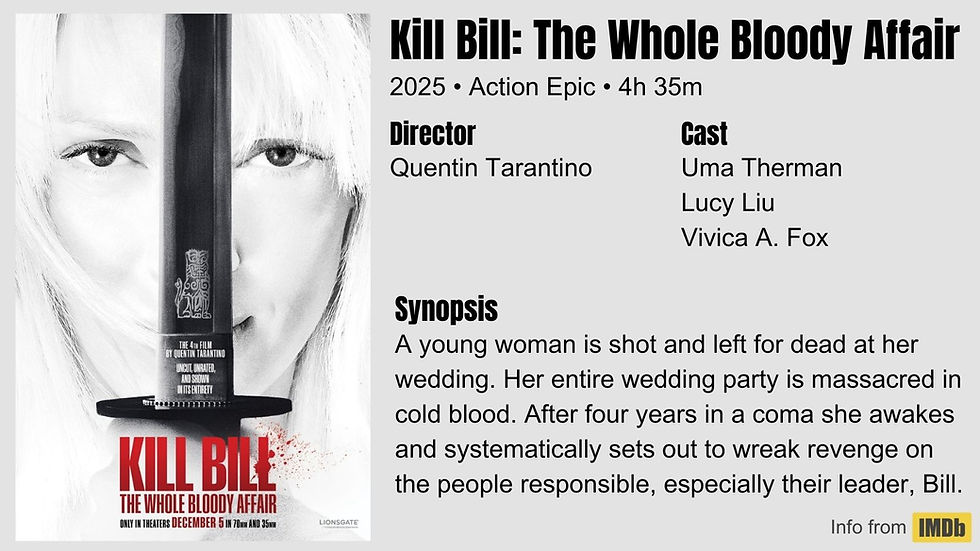
'Kill Bill: The Whole Bloody Affair' Review: Quentin's Tarantino's Samurai Epic the Way it Was Meant to be Seen

By Dan Bremner - December 10, 2025
Nearly twenty years after Quentin Tarantino first teased it, The Whole Bloody Affair is finally available the way it was originally meant to be seen: as a single, colossal, blood-soaked 4.5-hour epic with an intermission. What was once a myth, shown only a handful of times at the New Beverly and a couple of festivals, is suddenly playing in cinemas across the UK like it’s no big deal. The fact I got to see it locally and watch this in Dolby felt surreal, almost like stumbling into an alternate timeline where Tarantino still had passion for cinema instead of picking fights with journalists and whining about directors going “bad after ten films.” For all his recent public buffoonery, this release reminds you exactly why he became a cultural force in the first place: Kill Bill absolutely rips, and in this form, it transcends even its already-brilliant individual volumes.
There’s always been debate about whether Kill Bill is one film or two. Tarantino says one. The studio said two. Fans argue endlessly. I’ve always loved both volumes (with Vol. 2 increasingly becoming the stronger half as I’ve aged) but seeing them combined like this finally settles the matter, as this is unequivocally one story. A single revenge odyssey. The cut removes the psychological hard break between the volumes, letting the exuberant, hyper-violent pop-samurai madness of Vol. 1 bleed directly into the dusty, melancholy, dialogue-heavy spaghetti-western soul of Vol. 2. Instead of feeling like two separate cinematic moods, they’re now one continuous emotional and stylistic arc. You feel The Bride’s exhaustion. You feel her evolution. You feel her humanity clawing its way back through the carnage. It’s frankly the definitive cut, and I can't see myself revisiting it as two films again.
The biggest and most immediate treat of The Whole Bloody Affair is the restored colour version of the House of Blue Leaves sequence, long censored in the West. Seeing the full-blown, untrimmed arterial-spray mania in stunning colour on a big screen is transcendent. It’s everything Tarantino ever loved about the genre distilled into fifteen delirious minutes. The restored anime backstory for O-Ren is also breathtaking in its original colour grading, vicious, beautiful, operatic and gloriously excessive with its violence. This version isn’t just “slightly extended”, it’s a fundamentally richer experience, restoring the boldness and excess that were always meant to define these characters.
Across the four-plus hours, a handful of extended and previously unseen sequences slot neatly back into place. None of these additions radically alter the narrative, but cumulatively they enhance it, creating a cleaner, more cohesive arc. And the pacing benefits enormously, with the slow-burn patience of Vol. 2 no longer feeling like a tonal detour but a natural comedown after the maximalist insanity of Vol. 1’s climax. I could not believe how quickly 4 and a half hours went by in the cinema during this, I've seen films half this length feel longer (It's been 4 years now, and I'm still waiting for Marvel's Eternals to finish).

The theatrical presentation truly elevates the experience. From the grindhouse-style overture to the old-school intermission, this cut feels like an event. More than any Tarantino film since Inglourious Basterds, this reminded me how intoxicating cinema can be when the filmmaker knows how to turn spectacle, style, sound, and structure into one cohesive sensory feast. It’s the kind of screening where you can feel entirely locked in and it never lets up. It's very easy to hate Tarantino for his insufferable real-life persona, but when he puts a film out there, you're reminded he's one of the best to ever do it.
And then there’s the Fortnite Lost Chapter. I'm neither 12 years old or a virgin, so to me, this is a baffling, inexplicable, tonally discordant abomination inserted as a novelty bonus during the post-credit bumper, because apparently even Tarantino isn’t immune to letting corporate synergy shove its grubby hands into his filmography. It’s mercifully short, but watching cel-shaded avatars and Fortnite characters act like they’re promoting a battle pass is, frankly, one of the worst artistic decisions attached to anything Tarantino-adjacent. It doesn’t damage the film, as it’s not inserted into the narrative, but it’s a stupid, embarrassing footnote that will age like milk. Thankfully, it is after the credits, so I say walk out before that nightmare begins.
As for the film itself? It remains one of the greatest revenge stories ever put on screen. Uma Thurman gives a career-defining performance as The Bride/Beatrix Kiddo: fierce, vulnerable, tragic, and mythic all at once. Her physicality, emotional range, and sheer command of presence make her one of cinema’s most iconic protagonists. David Carradine is equally magnetic as Bill, effortlessly blending charm, danger, and philosophical melancholy. Their final confrontation remains one of the most satisfying climaxes Tarantino has ever written, simple, quiet, devastating, and perfect. I remember being disappointed it wasn't an action-heavy finale when I was 12, but as an adult, it's beautifully done and emotionally satisfying.
What really struck me seeing it as one epic is how much deeper and more coherent The Bride’s emotional journey becomes, especially regarding the daughter twist. In the two-film format, Beatrix discovering B.B. survives feels like a sharp, abrupt cliff-hanger, a brilliant moment setting up Vol. 2, but still a sudden gear-shift after an entire film of operatic carnage. Here, though, the revelation lands with devastating clarity. You’ve just spent four hours watching her endure trauma, violence, loss, and pure ruthless focus, and then the film allows that emotional shell to crack in real time. The build-up feels more earned, more tragic, and more humane, because you’ve witnessed her entire rampage without a year-long gap softening the edges. The tonal shift that once felt almost jarring now feels organic and inevitable, transforming the twist into the beating heart of the entire epic, the moment the revenge saga mutates into a story about motherhood, identity, and the cost of survival. It hits harder, resonates longer, and gives the finale a real emotional weight the split films do manage, but not as strongly.

Every stylistic flourish here is peak Tarantino: the kinetic camerawork, the whip-pans, the split-screens, the anime detour, the grindhouse sensibilities, the majestic spaghetti-western homages, the playful editing, the loud sound cues (When the screen flashes red and that alarm goes off is basically what happens whenever I see the Netflix logo before a film). The soundtrack is flawless, a masterclass in needle-drops ranging from Nancy Sinatra to Santa Esmeralda to Ennio Morricone (With some tracks he would later recycle in Inglorious Bastards). The supporting cast is stacked with icons: Lucy Liu commanding the screen, Vivica A. Fox delivers one of the best cold-opens of the 2000s, Daryl Hannah’s lethal elegance and pettiness, Michael Madsen’s weary menace, and Gordon Liu is a scene-stealer as Pai Mei, a glorious and hilarious homage to the Sensei’s of ‘70s samurai cinema. Every performer leaves a mark and they only get richer on rewatches.
And of course, seeing it all stitched together like this only highlights just how absurdly good Tarantino’s dialogue is when it’s allowed to breathe across one massive canvas. The man may be a walking collection of bad opinions these days, but when it comes to characters talking, monologuing, threatening, reminiscing, philosophising, or just bullshitting, he’s still one of the best to ever do it. The “Superman” speech is an all-timer, Budd’s bitter philosophies about deserving death, Elle Driver venomously recounting Pai Mei’s death, Bill’s soft-spoken cruelty, even side characters telling absurd stories about Hanzo swords or shady motel hits, all of it is a stark reminder of how Tarantino needs to get off podcasts and get back on his typewriter. The film becomes a symphony of sharply written voices, each rhythmically bouncing off the next, making even scenes without a single punch thrown feel just as electric as the action. When Kill Bill slows down, it doesn’t lose momentum, it simply shifts into a different register, and the dialogue becomes its own kind of violence, precise, cutting, and unforgettable.
Seeing Kill Bill in this form has only strengthened my belief that The Bride’s journey is one of Tarantino’s finest achievements. It’s everything he loves about cinema, revenge, emotion, music, mythology, genre, and sheer cinematic joy distilled into one four-hour odyssey that's as sharply written, packed with unforgettable characters, heart and extraordinarily violent action. The Whole Bloody Affair isn’t just the definitive cut. It’s one of the greatest cinematic experiences I’ve ever had, full stop.
'Kill Bill: The Whole Bloody Affair' is playing now in cinemas across the UK.

Want more film reviews? Check out more content on our website Film Focus Online!