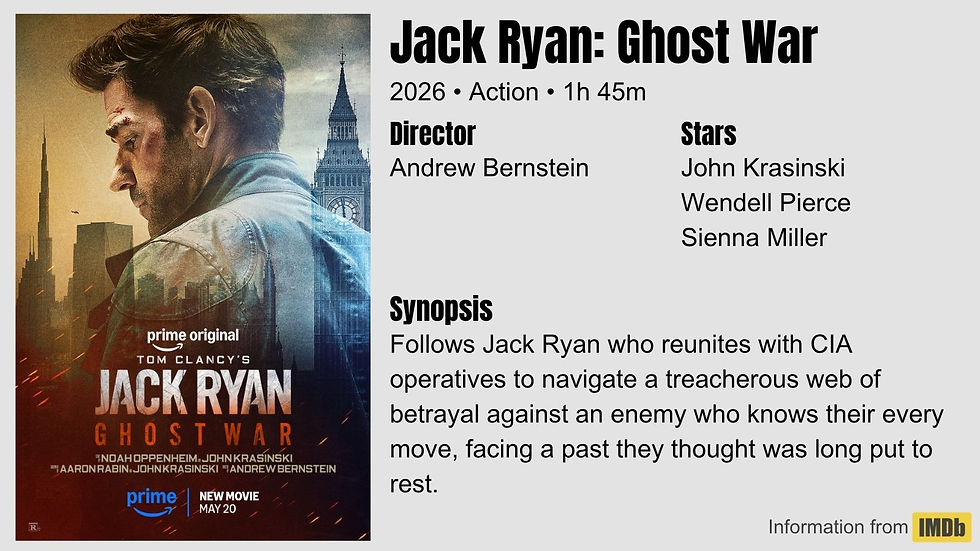
'Jack Ryan: Ghost War' Review: Jack Ryan's Return to Film is Bland and Forgettable Streaming Sludge

By Dan Bremner - May 29, 2026
The sixth entry in the Jack Ryan franchise and a direct sequel to the Amazon Prime series that ran for four increasingly dull seasons before finishing and immediately evaporating from my memory as completely as if it had never existed. I watched all four seasons. I could not tell you what happened in any of them beyond a vague impression of John Krasinski looking concerned in various international locations while the CIA did morally questionable things that the show presented as entirely necessary and justified, because this is pro-CIA propaganda your dad will earnestly describe as proper telly. There wasn't much excitement for this film going in, and the result is exactly what a complete absence of excitement deserved, a by-the-numbers and generically assembled espionage thriller that sits comfortably in the long tradition of Jack Ryan projects that arrive, fail to make any impression whatsoever, and are forgotten within a fortnight. The Chris Pine starring Shadow Recruit held that particular crown for years. It has company now.
This time around it involves a mole inside the CIA, a shadowy enemy who knows Ryan's every move before he makes it, a past operation with unresolved consequences that is now coming back to haunt everyone involved, and a ticking clock threat of broadly geopolitical dimensions that must be neutralised before something catastrophic occurs. If you are reading that sentence and experiencing a powerful sense of having encountered this exact sequence of story elements in approximately forty other espionage thrillers, you are correct and your instincts are sound.
Ghost War assembles its plot from the most thoroughly exhausted components of the genre with a confidence that suggests either total unawareness of how familiar all of this is or a complete indifference to that familiarity, and proceeds to execute each predictable beat with the mechanical efficiency of a production line rather than any discernible creative investment. The mole is exactly who you expect. The past operation contains exactly the revelation you anticipate. The climactic confrontation resolves in exactly the manner the genre's internal logic demands. There is not a single moment of genuine surprise, narrative ingenuity or dramatic tension across the entire runtime, just a series of familiar spy thriller components shuffled into their expected order and presented without the craft, atmosphere or character work that might have elevated the familiarity into something functional. It is the screenplay that may have genuinely been written by AI, as at the very least, if this was written by a middle-aged man who consumed nothing but spy paperbacks, there would at least be a fun trashy bit of personality here. Instead, there is nothing.

The fundamental problem, beyond all the specific and individual problems that accumulate across the runtime, is that this feels and looks exactly like a very expensive television episode rather than a film with any kind of distinct cinematic identity or ambition. The direction is pedestrian, the visuals are flat, and the whole thing carries the aesthetic of something assembled competently to fill a streaming library rather than crafted to justify the theatrical ambitions its budget theoretically allows. The early seasons of the show at least had a specific trashy, post-24 energy that made them watchable garbage in the way that good garbage can be, filling the particular niche of dumb geopolitical thriller that dads everywhere consume with the same uncritical appetite they bring to anything with a map and a ticking clock. This film has lost even that modest and dubious charm, replacing it with a generic procedural hollowness that generates no genuine tension, no investment in its characters and no memorable sequences of any kind across its entire runtime.
Krasinski as Ryan remains a fundamentally bland vessel for the franchise's particular brand of morally conflicted CIA heroism, and the screenplay gives him nothing new to do with a character who has been having the same moral crisis in slightly different international locations for 30 episodes of Streaming Content without arriving at any genuinely new position on the questions it keeps raising. The supporting characters are archetypal to the point of invisibility, the villain motivation is telegraphed so early and so heavily that anticipating each development becomes the film's only available entertainment, and the plot mechanics are simultaneously over-complicated in their exposition and under-developed in their execution, explaining a great deal while delivering very little.
The action sequences are functional and utterly unmemorable, generic in their construction and directed without the kinetic clarity or creative invention that would make them register as anything beyond obligation. Then there is the London car chase, which I feel compelled to address with the seriousness it deserves. A high-speed pursuit through central London. Through London. A city so comprehensively and catastrophically designed against the interests of drivers that a high-speed anything is a physical impossibility at virtually any hour of the day or night.
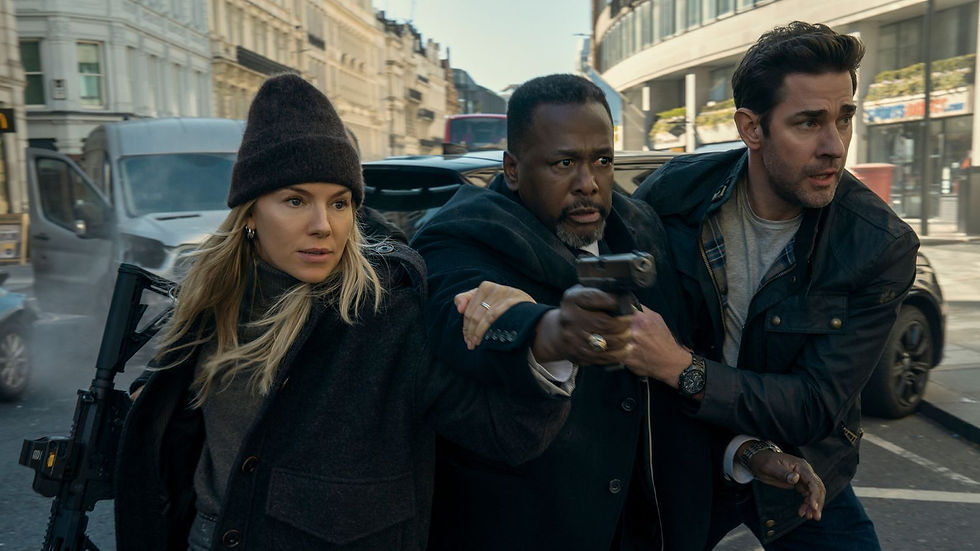
You are not conducting a thrilling vehicular chase through those streets. You are stopping every thirty seconds at a set of traffic lights, getting stuck behind a bendy bus on Oxford Street, failing to find a turning because half the roads are one-way in the wrong direction, and eventually pulling over to look at Google Maps in a state of quiet desperation. The sequence plays with complete and utter sincerity as a genuine action set piece and I spent the entire thing thinking about the reality of London traffic with a vividness that suggested my brain had found more interesting things to do than engage with what was actually on screen.
The '90s Jack Ryan films, The Hunt for Red October, Patriot Games, Clear and Present Danger, understood that the character worked best when the intelligence and geopolitical complexity of Clancy's source material was taken seriously and the thriller mechanics were built around genuine ideological and strategic tension rather than generic action choreography. Those films had personality, craft and a specific cold war and post-cold war intelligence that gave the franchise its identity. What has followed since has progressively diluted that identity into something increasingly indistinguishable from any other streaming espionage content, and Ghost War represents the logical endpoint of that dilution. Personality-free, hollow, drab and entirely inessential.
Jack Ryan: Ghost War is a very faithful follow-up “Film” to the Amazon Prime series. Of which I mean it's a generic spy thriller that is absolutely nothing you haven't seen done better hundreds of times. Flatly shot like an expensive episode of TV, John Krasinski continues to be a thoroughly dull Jack Ryan, and while there is some okay action, it's surrounded by such blandness that you won't remember a second of it once it finishes. What was I reviewing again?
'Tom Clancy's Jack Ryan: Ghost War' is streaming now on Prime Video.

Want more film reviews? Dive into more reviews, rankings, and film conversations on our site. Explore Film Focus Online now!